
Hermann Hesse’s The Glass Bead Game
Friday, 7 November 2025, 23:00–13:09
Author: Vojislav Karanović

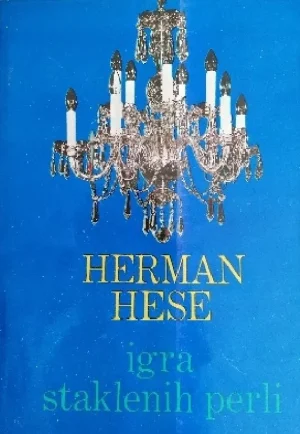
Our guest on tonight’s programme is Predrag Cicovacki, philosopher, writer, and professor. He talks about why he loves Hermann Hesse’s novel The Glass Bead Game. This is Hesse’s last and most ambitious novel. It was published in 1943, shortly before the author received the Nobel Prize in Literature. This philosophical novel combines elements of dystopian and intellectual fiction, taking readers into an imaginary future in which an intellectual elite lives apart from the world, in the spiritual and academic community of Castalia. The novel leads us into the deep and complex world of a game that draws on art, philosophy, and spirituality. Through this game, which demands not only skill but also profound introspection, Hesse raises fundamental questions about consciousness, individuality, and the significance of art in human life. Hesse reveals that the glass bead game is not merely a competition, but a profound reflection on human existence and the search for meaning.
Our guest discusses his beginnings as a reader, his first encounters with the world of books, and the works he loved to read. We hear how he discovered Hermann Hesse’s writings and why he regards The Glass Bead Game as an exceptionally valuable and inspiring work.
Predrag Cicovacki graduated in philosophy from the Faculty of Philosophy in Belgrade in 1984 and completed his postgraduate studies at the University of Rochester, USA, in 1991. He taught philosophy and peace studies at the College of the Holy Cross in the United States until 2023. He is now Professor Emeritus at that college and a Senior Research Associate at the University of Cambridge, United Kingdom. He has written thirteen books and edited twelve. He has published in English and Serbian, and his books and articles have been translated into Russian, Chinese, Persian, Spanish, German, French, Turkish, Slovenian, and Macedonian. He currently lives and works in Sombor.
Programme author and presenter: Vojislav Karanović.
Find the full interview here (in Serbian):
Source: RTS